Showing posts with label Archbishop. Ordinariate. Show all posts

Sunday, 26 February 2012

Rome Pilgrimage

Fancy us, being here! That was the constant cry from members of the Ordinariate of Our Lady of Walsingham throughout last week's Pilgrimage. There were around a hundred of us, incuding two deacons, ten priests, our Ordinary, and representatives from many of the Groups in England and Scotland. There are pictures elsewhere - find them from the Ordinariate's web page - so I shall just add a few of my own. We did not have much spare time, but on the afternoon of Ash Wednesday I managed half an hour in front of Saint Peter's to make a scribble - chiefly because you look more carefully and remember better when you have a pen or pencil in hand.


Sue sponsored Barbel and I sponsored Brian at their Reception

For our Bournemouth group the highspot was the Confirmation of Brian and Barbel Copus. They have been waiting for a year and more to have their marriage convalidated. That happened just days before we left for Rome, so Mgr Keith was able to confirm them - to their delight that occurred in the church of St George in the Marsh (San Georgio Palabro) which was the titular church of John Henry Cardinal Newman, our Patron. Their happiness was infectious, and the whole Pilgrimage rejoiced with them.


Perhaps, too, we should mention the Papal Audience - when, on our name being announced, we all stood and sang a verse of 'Praise to the Holiest' - not sure what the thousands present made of it, but they applauded and the Holy Father waved to us, and it seems we were also on the Tele. So that bit of the Patrimony has gone world-wide, thanks to EWTN. It was good to see Mgr Keith up among the great and good, and he conveyed the Pope's good wishes to all members of the Ordinariate.


Pope Benedict looked bigger on screen!

So much else to tell you about; a wonderful trip up into the snow (while the sun shone warmly) to see the Monastery of Scta Scholastica, and the Cave where St Benedict spent three years in preparation for his great work of founding Western Monasticism.

I had the good fortune to preach there, so I append a version of the sermon. You may skip it and just look at the pictures if you'd rather.


Vesting again!


SERMON in SUBIACO

We are just overwhelmed – so much to see, so much to take in. Here, for instance, the very birthplace of monasticism, where the Offices of the Church began to become distinctly Christian, growing away from their Jewish origins. There are those who claim that the Anglican Patrimony at its best is Benedictine, and that in Cathedral worship those monastic ideals continue. So should we look at Benedict and his sister, and learn lessons from them? Well, we could think of the complementarity of male and female, and how as Scholastica’s nunnery paralleled her brother’s monastery as much later Clare’s foundation underpinned the work of Francis – or again looking to England consider how important the dual foundation of Whitby was for the church of our land, and how Hilda exercised great influence – without ever being a priest! But then we have heard from the Abbot so much more about the history of this place, and our Tour guide has blown much of the story of Scholastica clean out of the water!


But time is short - so let’s focus on one small thing, the newly translated prayer for Scholastica’s feast day. There had been an ancient prayer recalling how Benedict had seen her soul ascend as a dove to heaven. By the 1980s there was instead a very pedestrian little effort; “that by her example we may serve you with love and obtain perfect joy”. Well, forget that. Look instead at what the new Translation has given us:-
‘That, following her example, we may serve you with pure love
and happily receive what comes from loving you’.
Not ‘perfect joy’ you see, that is altogether too trite, Better than that, we ask for what comes, whatever comes, from loving God. There’s a wealth of meaning in that sentence. The lives of Benedict and of Scholastica are lives of pure love for God; and that is what we ask for ourselves – “that we may happily receive what comes from loving you”. So what does come from loving God? Not just joy, surely. John Wesley understood it well – he is part of the Patrimony, a part we should not forget: here is what his followers pray each New Year:

“Put me to what thou wilt, rank me with whom thou wilt.
Put me to doing, put me to suffering.
Let me be employed for thee or laid aside for thee,
exalted for thee or brought low for thee.
Let me be full, let me be empty.
Let me have all things, let me have nothing.
I freely and heartily yield all things to thy pleasure and disposal”.

That is genuinely asking to love God.

Love is not without pain. There are those refuse love for fear of being hurt, people who can never commit themsleves to another person because it might bring pain.. Not so the saints, not so Scholastica. They risk loving God, for the joy of being loved in return. The pain that love brings them is worth it; love like that Jesus spoke of “A woman when she is in labour has sorrow – but as soon as she is delivered of the child she remembers the anguish no more, for joy that a man is born into the world”. (John 16.21) Can we pray too, that ‘we may happily receive what comes from loving you’?


The Shrine at Subiaco

Sunday, 15 January 2012

Happy Birthday!


Just a year old, but we had a very busy day celebrating the first year of the life of the Ordinariate of Our Lady of Walsingham. It began early, with a beautiful dawn. We had to drive over to Bournemouth in good time, for the car was laden with new goodies. First, the very handsome Lectionary, provided for us by the parish of St Mary the Virgin, Arlington, Texas. The Lectionaries had been awaiting collection at Allen Hall, and I fetched ours on Thursday when we met there with Msgr Keith.


Then with the Lectionaries were some new hymnals - well, new to us. They are copies of English Hymnal which the Anglican Parish of Holy Trinity Millbrook in Southampton has kindly let us have. They had to be offloaded before Mass could begin.

We also had visitors; Ronald Crane and Jackie Ottaway, editors of the Portal (now the OFFICIAL on-line publication of the Ordinariate in England and Wales) came to interview some of us, and take photographs after Mass.


It is too tedious to make another home trip to Lymington, so we stayed in the Church Hall of Our Lady, Queen of Peace, for an hour or so, then had a picnic lunch before setting off in our mini-coach.


One of our Ordinariate priests expressed surprise that we were coming all the way from Hampshire for the Ordinariate's birthday celebration. His group is based within twenty miles of Central London, but it was too far for them. Very strange thing, that when you are in or near London distances appear to multiply.
We left Bournemouth at 1pm and arrived at St James' Spanish Place in Marylebone (just north of Oxford Street) by about 4.30, and no-one thought the journey too long. Certainly everyone thought the worship well worth the effort. Others will no doubt blog about that, so I may save one or two pictures for the Anglo-Catholic.After Mass, a very jolly reception where we caught up with old frinds from Maidstone and Folkestone, Deal and Faversham, Essex and even a few from London.

The pictures here are just to encourage others to make the effort to get to any events commended by Msgr Keith. The next one, I believe, will be a Chrism Mass at 11am on April 2nd, also at St James' Spanish Place; details subject to alteration, but you could make a pencilled note in your diary now. See you there!

Sunday, 1 January 2012

A Jewish Mother

The internet is abuzz with news about the new arrival. Fr Jeffrey Steenson is to be the new Ordinary of the latest Ordinariate, of the Chair of St Peter. My own particular delight is that another former student of St Stephen's House achieves high office in the Catholic Church. Fr Scott Hurd trained with us there and now he is to be a top gun in the Ordinariate; Vicar General, no less. It couldn't happen to a nicer chap.

Here our little Group in Bournemouth is planning a coach for Jan 15 to take us to the Ordinariate Evensong & Benediction at St James', Spanish Place. There are still one or two seats left, so if you are interested let me know. We are hoping there may be a few from the Salisbury Group joining us, too.

This morning, we worshipped with the parish congregation of Our Lady Queen of Peace. Fr Gerry invited me to concelebrate and preach: and here is what I had to say on this happy day:

As for Mary, she treasured all these things and pondered them in her heart.

Mothers have a great gift – the gift of embarrassing their children. When the son brings a girlfriend home for the first time, there is mother with the photograph album, ready to let the girl see just what a geek the son was with those braces on his teeth. It is not done with any malice; it is just that to a Mother, her son is always that, her boy. And she remembers so much from his childhood, since it was so important to her. When she was in her nineties my own mother would speak about me. How old is your son now? they would ask. ‘Oh, about forty’ she’d say - very flattering, when you’ve already had your seventieth birthday; but she could just as easily have said “about twenty” or “about fifteen” – that’s how she remembered me.

So it was nothing extraordinary that Mary remembered the events surrounding her Son’s birth – every mother does it. But every mother does not give birth to the Son of God, and the time of Jesus’ birth has been remembered not just for a lifetime but for two millennia. And whereas the day I fell out of the pram, or the day I learned to ride a bike are just the sort of thing that happens to everyone, the day the shepherds came to the stable is eternally significant. Yet unless Mary had treasured these things and pondered them in her heart, they would have been lost to us.


So Mary is a typically proud mother, indeed a proud Jewish mother; but her son never studied to gain an ology (do you remember Maureen Lipman in the BT ads?) What Mary had to remember about Jesus was vastly more important; this child, she was told by Simeon, is set for the rise and fall of many in Israel. She was to be the Mother of her Lord, the Mother of God himself.

There was a Muslim scholar speaking on radio recently, trying to show how inclusive and reasonable Islam was; “but we believe the Bible”, he said, “we honour the prophet Jesus and his virgin mother.” Don’t be deceived. Like every heresy throughout history (and Islam is a heresy, a distortion of Christianity) Muslims pick and choose which parts of Holy Scripture they will believe and which they will ignore or deny. It was like that way back about four hundred years after the Resurrection, centuries before Mohammed was born. There was a false teacher, a monk called Nestorius, who refused to give Our Lady the title “Mother of God” – or rather its Greek version, Theotokos, the God-bearer. For two hundred years that had been how orthodox Christians spoke of the Blessed Virgin; she was the God-bearer. The person who first used the phrase was Origen, and it caught on as a perfect description for the role of Mary in the Christian story. She brought the Son of God into the world; she bore God in her womb. Well, Nestorius did not like it; to him it sounded as though this was damaging Jesus’ humanity. He was fully human – and Mary gave birth to a human son. Eventually it took a Council of the Church, the Council of Ephesus, to decide the matter. That decision we firmly hold, as Catholic Christians; that Jesus is fully human, and fully divine. The Blessed Virgin did not give birth to two sons, but to one, Jesus, and her Son is properly called Son of God and Son of Man.

In all this, the Church relied on what Mary had remembered and what St Luke and others had written from what she told them. She who had seen and heard and experienced all these things treasured them, and pondered them in her heart. She is, before anyone else, the first Christian theologian, the one who contemplated the mystery of Jesus’ birth and realised that this was, indeed, Son of God.

You will find Christians who shy away from the word ‘theology’. They say they are simple Christians, and they are worried by dogma. Theology, though, is simply an attempt to find out the truth about God, and give a coherent account of Him. Doing this, we also have to discern the truth about his creation, especially about human beings. That was the aim of those who wrote scripture; from the first page of Genesis, the question is how mankind came into existence, and how we are connected with our Creator.

The Nativity of Jesus is the greatest step in this journey of discovery; that is what this whole festival is showing us. When the appointed time came, as the Epistle tells us today, God sent his Son, born of a women, born a subject of the Law; that is, he was fully human, governed by the laws of nature as we all are. Unless he had been like us in this, we could not have become like him. But he is truly Son of God, who is sent into the world; and so the Spirit who is in his Son can interact with our spirits, enabling us to cry Abba, Father.

This is why theology matters. The Church’s teaching about God and man is based firmly on Holy Scripture - and especially on how Mary kept all these things and pondered them in her heart. When we pray, when we work at the meaning of the words of Scripture, when we wrestle in our minds with the teaching of the Church, we are honouring Mary – for this is what she did, and our praying and pondering continues her work in this generation. So you see after all this Jewish mother is concerned about an ology. Not Sociology, like Beattie in the ads; but theo-logy; the study and knowledge of God himself.

If Mary had not treasured all these things, from the visit of Gabriel to the birth in the stable, from the visit of the shepherds to the need to become refugees in Egypt, if she had not pondered these things and entrusted their meaning to Our Lord’s disciples, our knowledge of God, our theology, would have been very deficient. As it is, we can trust Mary the theologian more than any other teacher; and part of her lesson is that we can become a little like her if we will treasure these things, and ponder them in our heart too.

Tuesday, 17 May 2011

Heavy Day at Allen Hall

My, we've been worked hard today. First there was our homework; studying ethical questions with the help of Donum Vitae (produced by the CDF) and Familiaris Consortio of John Paul II. To guide us through these documents, and lead us beyond them, we had the help of Fr John Wilson (left) of the Diocese of Leeds (and formerly of Ushaw College). Many of us former Anglican clergy are married, so the questions raised were particularly personal to us and our families. For me, the pastoral approach of successive Popes in considering these matters is what predominated.


Then, we had our Ordinary with us - he celebrated Mass with us at the end of the afternoon. (here at lunch with the Archbishop)


The icing on this very rich layer-cake was a visit by our Archbishop of Westminster, Vincent Nicholls, who spoke to us and answered questions in the half-hour before lunch. It is good to know that the Ordinariate is so high on the Archbishop's agenda that he found time to visit us in this way (and there will be a team photograph to prove it).


Msgr Keith also spoke briefly, comparing and contrasting his experiences of the House of Bishops of the Church of England and the meeting of the Catholic Bishops of England and Wales. From my own time in office I would agree that the Anglican meeting was not one to which I ever looked forward with enthusiasm. Clearly his experience with the Catholic Bishops in Leeds last week was an altogether happier occasion.


These sessions at Allen Hall are proving hugely valuable for all of us newly or soon-to-be ordained. It is good to be looking in some depth at questions of human life and reproduction which seemed to occupy so little thought in our former communion.


To be able to direct the faithful to authoritative summaries of the Church's teaching is a great gift - to be able to explain them clearly to our people, in the confessional or in sermons, is a huge responsibiity. The informal discussion we have over meals or in the short breaks between lectures are very important for the creation of a coherent pastorate within the Ordinariate. Though it is an expensive business getting up to London week by week, it is not something I would want to miss.

Sunday, 24 April 2011

No Ordinary Easter


Ed Tomlinson gives out a notice (right)

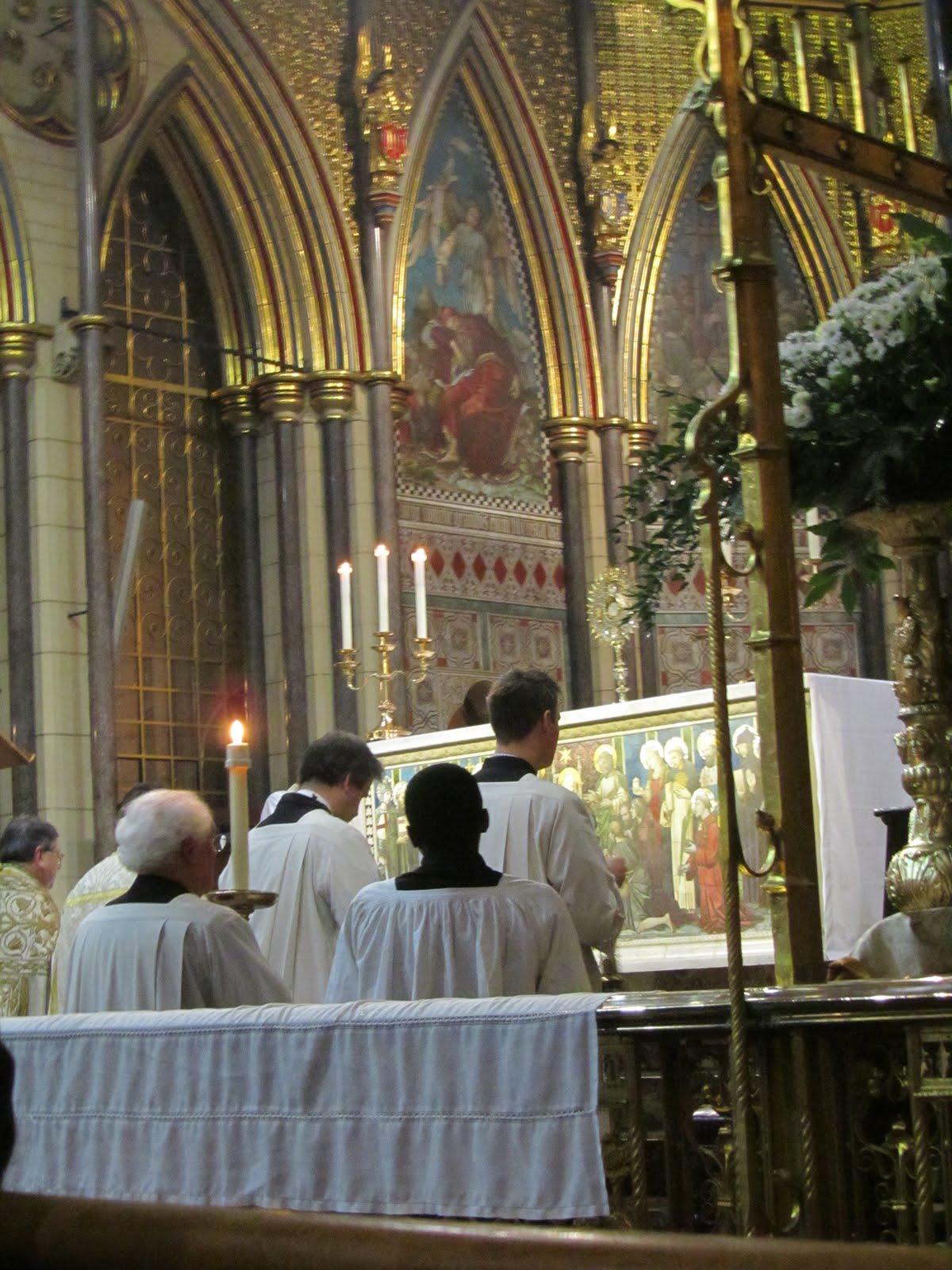
It was great being able to share in the Triduum in an Ordinariate setting; not a parish yet, since its priests await Ordination - but certainly a wonderful group of people, eager to begin the task of Evangelisation as members of the Ordinariate of Our Lady of Walsingham.

Jane and I were given great hospitality in Tunbridge Wells. Soon-to-be Father Nicholas Leviseur (formerly NSM assistant at S Barnabas', and alredy assisting Ed Tomlinson in setting up the Ordinariate, to be based in Pembury) is a great host, and with his wife Mary and their four children they made us hugely welcome.

Since Ed, in his own blog, encouraged me to do this, I am posting a version of my sermon from the Easter Vigil Mass. Printed sermons never quite do the job - they need to be spoken and heard - but for what it is worth here it is.

Towards dawn on first day of the week, Mary of Magdala and the other Mary went to visit the sepulchre. Mtt 28.1

The more we look forward to something, the longer the waiting can seem. Do you remember that interminable time when you were a child, and grown-ups would say “Christmas will be here very soon”. It did not seem soon to you; and if you were awake on Christmas Eve, the night was endless. Now though we are grown-up and we’ve been getting good at waiting. Though truth to tell we have not been in the queue very long. Others who have joined the Catholic Church have undertaken much longer preparation; and especially this is so for priests. I hope to be at a friend’s Ordination next December; and he became a Catholic four or five years ago. But Lent will have seemed long this year for all that, Lent without the consolation of Communion. And for your two pending priests, Eastertide will seem a long stretch.

The women who came to the tomb had a shorter wait, but then they were not looking forward to what was to come. Dreading it, probably. It had been a rushed job on Friday, just a couple of hours between taking the body off the Cross to getting it as decently entombed as possible before the Sabbath. No chance to put flowers on the grave; no proper ceremony, washing the body, spices and prayers. Just a couple of cloths to wrap him in, and his blood was congealing and staining those wrappings.

So they expected a gory sight, if ever they managed to get the stone rolled back. Perhaps the guards would help? They would not be able to do it by themselves. There had been a gang of soldiers to obey orders on Friday .. just a day and two nights ago. They had been told to make it secure; and so they did. Not just with that great boulder to shut it up, but official seals to secure it, and a guard to ensure there was so tampering with it. The authorities were prepared in case his disciples came to steal his body.

That is what is convincing about the Easter Gospel. What they confronted on Easter morning was totally unexpected. Death and decay and depression is what they thought would meet them; and it was not like that at all. Instead, an open grave – something incredible had happened.

Would you say that already in the Ordinariate you are beginning to find another sort of resurrection? We were fearful – well, maybe you were not; I certainly was, and so was my wife. How would these cradle Catholics treat us? After all, we are a strange bunch; arguing all the time until only a few months ago (and how we did argue) that the Anglican Church was a model for all Christian Churches – we even heard our Archbishop telling that to the Pope. Then getting disillusioned and jumping at the Holy Father’s offer; only to wonder just what we had let ourselves in for. Last Tuesday, for us, Jane and me, was one of those little resurrection moments.

We had been at the Chrism Mass, and that was great, and the music better than we dared hope. But there was an ordeal to come; lunch with the clergy. Eighty long-established celibate Catholic Priests, and us. We need not have worried. Priests came to introduce themselves, and the moment we said the word 'Ordinariate' they would say 'Welcome', and their smiles showed they meant it. Then we came upon four former Anglicans, two of them married men, who had all joined the Church a few years ago. They and their wives seemed happy to show us off to their friends. The fear of what we would meet was replaced by a prospect of new and wider friendships than ever we had known in the past.

Now of course it is foolish to compare our happiness at becoming Catholics with the pure astonished rapture of the women at the tomb, and the disciples. Our experience has just affected us; theirs has changed the whole world. Except, perhaps, that these little beginning, here in Pembury or with our Portsmouth Ordinariate groups are a new flowering of the Resurrection; little events which will give hope and confidence to more people than we can imagine. Easter is always the same, but always different. For you the differences are very plain; no cavernous spaces of St Barnabas’ to help lift up your hearts. Until now you have been able to rely on the generosity and the prayers of those who preceded you in that place.

Now, it is for you by your love and your prayers to make a new home, a place where many will feel welcome. It may be, too, that St Barnabas’ had served its purpose. We who were familiar with it thought it friendly; but that was not always the first impression of those going into it for the first time. There, it was possible to be satisfied with keeping things going; here, there is a job to be done. We need to keep in touch with our former Anglican friends, to ensure by our kindness that we don’t put up barriers. We will be looked at by many to see just what sort of a go we can make of being Ordinariate Catholics. It is a hugely exciting resurrection task that faces us; but we were not just seventy-two who came here. With us, ahead of us even, came our Blessed Lord, who well knew in his time on earth about having nowhere to lay his head. Now He is here, He is with us, He is risen! This is how it was the first Easter; filled with awe and joy the women came quickly away from the tomb – and went and told the others. Let that be our experience too this joyful Eastertide; filled with awe and joy, let us go and tell the good news to everyone we meet.

The Triddum was completed today with a visit by the Coadjutor Bishop in Southwark, Mgr John Hine. Here he is flanked by the parish priest and me, and the two priests-in-waiting, Ed and Nicholas.

Friday, 11 February 2011

More Revs


Today was very good. Bishop Crispian of Portmouth made us very welcome, and although there was only a handful of us in his private chapel for my ordination to the diaconate, we had some good music. For Our Lady of Lourdes, we'd chosen a bit of the Anglican Patrimony. We sang as an introit: Bishop Ken's "Her Virgin Eyes saw God Incarnate born", to Lawes' tune 'Farley Castle'. I was not the solitary deacon on parade; Stephen (good name for a Deacon) Morgan, who is finance secretary to the Diocese, propped me up and ensured I did not fall over my feet. He is the handsome chap on the Bishop's right hand. To his right is the Chancellor of the Diocese.


Jane, formerly known as the Flying Buttress when I was a Flying Bishop, was also present but as ever wanted to take a back seat. She was eventually inveigled into a photograph. We had a very jolly lunch after the Ordination. Bishop Crispian is clearly keen to make the Ordinariate work in his diocese, and has given great encouragement to the three groups in his territory which are in process of formation. As he pointed out, my duty and that of my fellow priests is not to him but to our Ordinary, and he was only able to Ordain me because he had been asked to do so by Fr Keith Newton. For all that, he is doing everything he can to ensure that we are made welcome by all the catholic clergy and laity within his diocese. For ourselves, I must say Jane and I have felt a great warmth of affection and a welcome we could not possibly deserve. If anyone is holding back from the Ordinariate fearing that a clergy wife might not be welcome, please speak to Jane or any of the other bishops' or priests' wives who have made the journey. I hope that even after our local Anglicanorum group is running, I shall still be some use to priests and parishes in this southern part of Portsmouth diocese.

Wednesday, 22 September 2010

Joining the Ordinariate


+ Andrew Burnham, Bishop of Ebbsfleet and PEV for the Western half of Canterbury Province, has published the third of his series of pastoral letters. Since I am constantly being asked how things are going towards the Ordinariate, and constantly have to say "Be patient; wait on the PEV's", now that a PEV has spoken, it is good to be able at last to quote direct from the horse's mouth:


Bishop Andrew Writes:


In this, the third of a series of Pastoral Letters, I promised to address the issue of the English Ordinariate. In August I looked at what had happened at the General Synod in York and in September I looked at the business of electing a new General Synod. Those who join the new Ordinariate, offered by the Pope in Anglicanorum Cœtibus in the autumn of 2009, will do so for one of two reasons. One reason would be that, looking hard at the General Synod, past and future, there seems little prospect of adequate provision for Anglo-catholics in the Church of England. We don't need a glasshouse with a special climate, or an Indian Reserve where we can do strange dances round a totem pole, follow strange customs, and wear strange clothes. Still less do we need some kind of nursing home where we can live out our days in peace and quiet. In our view, the Anglican orders of bishop, priest, and deacon, and Anglican sacraments, are either the ancient orders and sacraments of the Church, as they have been handed down to us from the time of the apostles, or they are not. You can't muck about with orders and sacraments! If Anglo-catholic orders and sacraments are not the same as those of other Anglicans, we are not proper Anglicans, and if Anglican orders and sacraments generally are not the same as those of other Catholic Christians, East and West, then our orders and sacraments are not Catholic. Our main problem is not with our own orders and sacraments at this present moment in Anglo-catholic parishes, but what has been happening with other Anglicans. This has already begun to affect our orders and sacraments and what they will be in the future.There are stories of people no longer being baptised 'in the name of the Father, and of the Son, and of the Holy Spirit'. There are stories of people - even a dog! - being admitted to Holy Communion without being baptised. There are stories of people no longer using wheat flour and grape for the Eucharist or making up the order of service as they go along. There are stories about lay people presiding at the Eucharist. There are marriages of two people of the same sex. These are mostly stories from overseas but, leaving aside what is happening in the Anglican Communion, we are now challenged in England by the prospect of women bishops, an unscriptural development. In short, the first reason for joining the Ordinariate might be that Anglo-catholics are no longer confident that they belong to the Catholic Church whose Faith and Order has been handed down from the apostles. If we finally came to that conclusion, that would be a good reason to seek to join one of the ancient branches of the Church, East or West. If we made the decision to explore the ancient branches of the Church, that, in turn, might be a reason to choose to join the Ordinariate, part of the ancient Church of the West. The second reason for joining the new Ordinariate is, I think, a better one. It is not about leaving anything behind but about joining something new. It is not about leaving a body which has gone astray and belonging to a more reliable body. The second reason works something like this. Anglo-catholics have always thought of themselves as separated from Rome - from the Pope - by circumstances of history. Henry VIII's divorce from his first wife was made possible by divorcing the whole English Church from the Holy See. The King was to be in charge of the Church and not the Pope. It is for this reason that we have been brought up on a diet of 'No popery!', the propaganda of the Tudor state and of Stuarts imperilled by the gunpowder plot. It is for this reason that the heir to the British crown cannot be a Catholic. Anglo-catholics have generally regretted this and seen it as necessary to do all they could to bring about a reconciliation with Rome. No one has been more enthusiastic about the work of ARCIC, the Anglican-Roman Catholic International Commission, this last forty years, than Anglo-catholics. And yet as the work of ARCIC goes into its third phase, Anglicans and Roman Catholics have grown further apart. It is for this reason that the Holy See has responded to the plight of Anglo-catholics with the offer of an Ordinariate. In short, the second reason to join the new Ordinariate is because it is the way - and for the foreseeable future the only way - that groups of Anglicans can become reconciled with Rome, and embrace the ministry of Peter. It is the only way of pursuing together our ecumenical agenda, the urgency of which becomes more obvious, the more Christianity is under attack by secularism. Joining the Ordinariate is not a matter to be considered lightly. Clergy who do so put their stipends and pensions, their homes and their security at risk. In some cases the response of laity will be so enthusiastic that whole congregations might be able to move together, with their parish priest. In most cases, the Ordinariate groups will be church-planting new congregations, congregations of perhaps only thirty or so people to start with, but thirty enthusiasts nonetheless. Such congregations of activists will probably grow rapidly, but there, of course, lies another risk. There are many clergy and laity who would love to possess the courage for this pioneering venture but they simply do not. Not everyone is at heart a risk-all pioneer. Not everyone can be: we all have real responsibilities to families to balance against the radical demand of the Gospel. And where do Ebbsfleet congregations, their clergy and people, stand in relation to all this? I want people to make decisions about the future carefully and prayerfully. I set out a prospectus for some of this a few years ago. There are, I think, three different responses to the present emergency. None is right for everyone. One is what I called the 'non-jurors', those who soldier on, know that they are a dying breed, but are content to be witnesses of what they have always believed and practised. Some mainly elderly clergy and congregations are of that view. The second group are the 'solo swimmers', individuals who go off on their own and join the local Catholic congregation. The third group is the 'caravan'. By this I don't mean a holiday home. The 'caravan' in biblical times was something like the trek of the Children of Israel from Egypt to the Promised Land, via Mount Sinaï. The caravan is large and ramshackle, camels and people trudging along, children running around and playing . There are new-borns in the caravan and people dying. People join and people leave. The beginning of the caravan is somewhere ahead of us, over the horizon. The back of the horizon is way behind us, further than eye can see. This, I think, is, for many, the Ebbsfleet journey. This was the theme, the Exodus theme - Marching towards the Promised Land: a Land of Milk and Honey - at our joyful Festivals of Faith. May God bless you as you faithfully seek to serve him in his holy Church.
+Andrew.


I am hugely grateful to Bishop Andrew for spelling this out. I think there are still some questions; for instance, I hear from isolated Anglicans who want to belong to the Ordinariate but can find no group near them which they can join. That is something for all the PEVs, and the Ordinariate itself, to tackle with urgency. Perhaps they already have the answer; on Friday there is to be a meeting for clergy in London which might make things clearer. Meanwhile, keep the prayers going. The Holy Father's visit has been a wonderful encouragement. He has given us the offer of the Ordinariate. We must not let him down.

Friday, 5 March 2010

May I suggest?


May I suggest you take a look now and again at The Anglo-Catholic? I've had one reader ask if I might repost items here which appear on that other blog, but I hope for now the link to 'The Anglo -Catholic' will be enough. What has astounded me in the week or so that I have been contributing to it is the sheer number of comments in produces. Perhaps I should have steered clear of liturgical matters - I dared suggest that maybe we do not always have to use "Thee" and "Thou" when addressing the Almighty, and it was as though I had shouted an obscenity during an investitute at the Palace. I was just trying to help our former colonial brethren to understand why it is that many of us are rather less wedded to the BCP and its derivatives than they are.


In an inspired moment (as it seemed to me) I realised that they were usually FORBIDDEN to use the old forms, so naturally the Prayer Book became a banner of revolt; whereas here it is THE legal form of worship. If an incumbent and his PCC cannot agree, then the fall-back position is BCP (I suspect not all PCCs know that!) They think using the (American version) of the 1662 book is a symbol of Orthodoxy; we, on the other hand, usually think it is horribly Erastian and un-Catholic. If you want to see the furious responses, have a look at two recent Posts of mine at The Anglo-Catholic called "More Patrimony" and "Patrimonial".
* * * * * * * * * * * * * * * * * * * * * * * * * * *
The illustrations are from the Title Pages of Prayer Books I own; an early 18th C copy of 1662, the deposited book of 1927, and the pseudo-Baroque frontispiece from the Anglican Use Catholic Book of Divine Worship of 2003. The Angels at the top look suspiciously like cribs from Durer, the rest I think is pastiche. But maybe you know better?

Tuesday, 9 February 2010

How long, O Lord?


Dear Archbishop Rowan is once more engaged in circle-squaring. It was handed over to the Manchester Commission, and they have been able to propose nothing; except this:


..."after more than six months work we had rejected all the options which would have involved conferring some measure of jurisdiction on someone other than the diocesan bishop. The legislation that the Revision Committee sends back to the Synod will, therefore, be on the basis that any arrangements that are made for parishes with conscientious difficulties about women’s ordination will be by way of delegation from the diocesan bishops. That much is already clear."

So that much is clear; and it is in the light of that decision that we should hear what the Archbishop is saying. In his address to Syond today he summed up the position "for both many women in the debate and most if not all traditionalists, there is a strong feeling that the Church overall is not listening to how they are defining for themselves the position they occupy, the standards to which they hold themselves accountable. What they hear is the rest of the Church saying, ‘Of course we want you – but exclusively on our terms, not yours’; which translates in the ears of many as ‘We don’t actually want you at all’."
Ipse dixit: we have been saying, as loudly as we possibly could, that delegated authority will not do. Whoever is to be our bishop must believe with us that women may not be ordained, and must have authority over us. That, says the Manchester Group, is not possible.

So what does Archbishop Rowan have in mind?
First, as so often, he askes another question: "what are the vehicles for sharing perspectives, communicating protest, yes, even, negotiating distance or separation, that might spare us a worsening of the situation and the further reduction of Christian relationship to vicious polemic and stony-faced litigation?" In other words, how do we get the jolly old Indaba process going to prevent us from reaching any conlusions?
He does hint at a way forward: Restraint. But not over women's ordination, that is clearly a done deal - despite all we were told about there being 'a time of Reception until the whole church, Eastern and Western, was of a mind'. No, restraint is what he proposes - but only over the LGBT issues (and no, that is not another version of a bacon sandwich - BLT- keep up!)
"Sometimes that may entail restraint – as I believe it does and should in the context of the Communion – though that restraint is empty and even oppressive if it then refuses to engage with those who have accepted restraint for the sake of fellowship". Restraint, maybe - but not delay over women in the episcopate, it seems. Only over Gay issues.
So it is back to circle-squaring. " Whatever we decide, we need to look for a resolution that allows some measure of continuing dignity and indeed liberty to all – in something like their own terms". Somehow, some day, the Synod will discover the magic elixir... giving us "something like" what we need. But what we need is Jurisdiction for our bishops, not lent them by women bishops when and if they see fit, but by law. And that, as the Bishop of Manchester has made clear, just is not on offer.
Rowan again: "as Christians we somehow have to add to that the question of how granting any freedom anywhere is going to set free the possibility of contributing to each other’s holiness".

Well, Rowan, we must tell you there is a way to set us free. It is to go ahead as quickly as you can to consecrate women as bishops, making no sort of provision for us at all. Any provision you make CANNOT give us what we need and have consistently asked for, so GET ON WITH IT: and set us free. Don't concern yourselves with what happens to us. The Good Lord will provide - and if Parliament's concern to ensure justice when women were first ordained is renewed this time round (by requiring there to be financial provision for us) so be it.

Only so is there any hope of your "contributing to (our) holiness". We do not want to be endlessly arguing about this issue. We have the offer of an honoured place - a real one - from the Holy Father, so just let us go. It will be sad to bid farewell to the church of our life's ministry; but that church is now just ancient history. We look to a better future. And we hope you too will enjoy your purified church with its broad open vistas without glass ceilings for women or LGBT bishops.

You said it yourself in your address to Synod; there might have to be "an unwelcome degree of distance" between us - just remember sometime though, that it was not we who chose to go, but you who made it impossible for us to stay.