Saturday, 15 September 2012

Our Lady of Sorrows


Mgr Keith Newton, our Ordinary, preached very movingly and simply on the Sorrows of Mary on the Ordinariate's pilgrimage day in Walsingham (r. the Slipper Chapel, part of the Catholic Shrine). For all that, the keynote seemed to be one of joy. Such a brilliant sunny day (compensation for last year's deluge); a great turnout of the faithful (some had to stand throughout the Mass for lack of room); some forty concelebrating ordinariate priests. We had a great deal to be thankful for.


Jane (rt) with Daloni and Michael Peel


So after our 450 mile two-day round trip, I thought I should post at least a few pictures for those of you unable to be present. It was only through the kindness of our old friends Dr Michael Peel and his wife Daloni (formerly i/c the College of St Barnabas) that we were able to break the journey with an overnight stop at their home in Suffolk.


Mgr Keith greeting members of the congregation after Mass.


Fr Aquilina from Sevenoaks with Mgr Broadhurst
Settling down for a picnic - some of our Bournemouth Group in the forefront

A merry post-prandial trio of priests


a South London seminar sur l'herbe.


and a pair of Ellises comparing notes


Bishop Lindsay Urwin welcomes us to the Anglican Shrine where he is the Administrator


Monday, 10 September 2012

There's none so deaf as those who won't hear

We are getting ready for the Ordination of two new priests in twelve days' time, so no opportunity for new blog thoughts. Instead, you might like to argue with this, Sunday's sermon -

'He even makes the deaf hear and the dumb speak'

It was because of the Paralympics that the Sunday programme was discussing the Bible’s attitude to disability. Once again, the BBC was parading its so-called liberal attitude; which less kindly we might call its unfailing Political Correctness. So we had a blind theologian complaining that the image the Bible gives of disability is often very negative. It uses ‘blindness’ as the equivalent of stupidity, because Jesus tells the Pharisees that they are blind fools. Much better, said the unsighted theologian, to have called them stupid fools. So just imagine the outcry from the community of the congenitally stupid. The blind professor said his blindness was none of his fault; but then neither is stupidity or foolishness. There was even a suggestion in the programme that by healing the blind or the leper Jesus was altering people’s situation for the worse. Much as you will be told that Christian Missionaries in the 19th Century should not have preached the gospel to head-hunters or cannibals because that was their culture.

Well it’s a great deal of nonsense, of course. Blindness is a dreadful affliction, and if we can cure it we should; but so often Jesus contrasts the physical disability of a person with its far worse spiritual equivalent. When he healed the man born blind, the Pharisees wanted to pretend it had not happened; they wanted to shut their eyes (I suppose that is not an offensive image) they wanted to shut their eyes to the truth. They did not want to acknowledge what was plain for all to see; that a man born blind had been cured.

So in today’s Gospel it is deafness, the inability to hear, which is Jesus’ concern. He does not blame the deaf man for his disability; but if he wants to be cured, then he can be. A far greater concern for us should be why some people are cured as a result of prayer, and some are not. A great friend of mine, a loyal trusting Christian, had a cancer which the doctors told him was terminal. He was sure he would be cured; and he was not. So why did God make this, or let this, happen? Come to that, why does he not cure everyone? And why in his own lifetime did Jesus not cure all who came to him? “Because of their unbelief” says one of the gospel writers – and certainly Jesus values a person’s faith, and often tells them that is their faith which has made them whole.

It is a very mysterious business, sickness, and disability, and healing. A young disabled boy in a class my wife taught said “If Jesus was here I would not be like this”. That boy died long ago. But if we believe the Gospels at all, then we must know that the Lord was concerned about him then, and still is. Surely that sort of faith is not ignored by God. On the contrary, when to his surprise the boy, after his death, found himself in the presence of Jesus, he will surely have been told that it was his faith which had brought him there.

He has done all things well, they said: he has made the deaf hear and the dumb speak. But far more importantly, he has given sight to the spiritually blind, and hearing to the morally deaf. These are the things that really concern the Lord about us, and they should concern us too. If only the Pharisees had admitted their own blindness; but they did not, and so they were condemned.
That same discussion on the Sunday programme tried to link disability with sin. Jesus said to the paralytic “Your sins are forgiven you”. This caused anger – ‘who can forgive sin but God only?’ they asked. So Jesus said, ‘Which is easier, to say your sins are forgiven, or to say take up your bed and walk; but that you may know that the Son of man has power on earth to forgive sin (he said to the sick man) get up, take up your bed, and walk’.

Now despite so-called theologians on the BBC, that is NOT, most definitely is NOT, saying that the man was sick because of sin. In fact when they asked about the man born blind “who sinned, this man or his parents” Jesus told them they were wrong in looking for a connection between sin and disability; and he says much the same in other places .. when people are killed by a falling tower, was it sin that brought this on them? Not at all. They are no worse sinners than anyone else.

The truth is, if we are to use language at all we are bound to use similes and metaphors. Spiritual blindness is like being incapable of sight. It is not saying that those who are physically blind are also morally bad. Any more than if I talk of the blackness of despair I am thinking that all Africans are despairing, if I say that a Government policy is just limping along I am saying to be crippled is to be a politician. Of course we must not use language to hurt others, and in this time of great sensitivity we must try to think how others might feel. But to forbid words like “black coffee” or “blind rage” would be to require us to use some language other than English.
And what language should we use? There are doubtless parallels in French and Italian, and probably in Chinese and Swahili. All that’s left to us is to say “I’m feeling a little blue” – and even that might offend some Tories – and as for “in the pink”!

So, just be a little careful about assuming that the BBC is impartial and truly liberal. It is infected with the diseases of the present day - and I hope no one with a cold will take this simile amiss – they need our generous criticism to help them realise that they are every bit as prejudiced as everyone else. Except that unlike us poor sinners, the Media think they are always right.


Saturday, 1 September 2012

Croydon & the Ordinariate


Few landmarks are left of old Croydon, the town I remember from my youth - my grandmother lived just one stop along the line, in South Norwood, hard by Selhurst Park, home of Crystal Palace football. One thing that is left, though, is St Michael's
Church. Left it certainly has been for many of those in the congregation today in St Mary's Catholic Church (just a stone's throw from St Michael's, though no one was throwing stones today). There were servers who had been at St Michael's, and some of the ladies from that parish were introducing one more element of Anglican Patrimony, the Mantilla, into Catholic worship. Fr Donald Minchew, its former Vicar, was among those ordained to the Catholic priesthood this afternoon.
Once you might still discern the little country town on the chalk hill (the meaning of Craie-dune or Croydon) among more modern buildings. Now it is distinctly part of the metropolis, and none the better for it. But today was lovely; the ordination of three priests, former Anglicans, by the Archbishop of Southwark in the presence of our Ordinary, Mgr Keith Newton.


There are few opportunities for concelebrants to take pictures in church; but before the event a number of distinguished figures hove into view. Fr Lindlar from Deal (right) was composing himself with holy thoughts. In another corner of Kent, and another corner of the room, the former Vicar of St Peter's Folkestone was on his mobile - at a guess, to his bookmaker, though I might be mistaken. He could very well have been checking up on the builders, who seem to have taken up residence in the house where he and Tricia and struggling to create a home.


Then also from Kent were two familiar bloggers, Frs Tomlinson and Aquilina, keeping each other up to date with their parts of the Ordinariate vineyard.


Most of those present were from London and surrounds; so it was good to have a fellow resident of Portsmouth Diocese, Mgr Robert Mercer CR, concelebrating.


Here he is being interviewed - or possibly engaged in conversation - by our intrepid communications officer, Fr James Bradley, who will no doubt by now have a sheaf of pictures on Flickr (whatever that is).


There were a few monsignori in evidence. Above on the left is Mgr Broadhurst, leading our Ordinary, Mgr Keith Newton, and the Archbishop into church. I did manage to get one shot in Church of the three Candidates, still in their diaconal stoles, as the Mass was about to begin.


From left to right are the Ordinary, then Frs Kenneth Berry, Paul Gibbons and Donal Minchew.


It was a great occasion, with a first-rate bunfight; it made our journeying from the South Coast (setting off at 8.15 and arriving home at 19.45) well worthwhile - quite apart from sitting on a table being regaled by Joanna Bogle with tales of Croydon Airport. Altogether a great day for the Ordinariate and for the Church at large.


Sunday, 26 August 2012

Stirring Times


For the past few weeks our Bournemouth Group has been meeting after Mass for half an hour of study and instruction. We are together preparing a family (parents and three sons) for reception; then today another Anglican, who has been worshipping with us, decided he too must seek admission. So little by little we are growing, and it is good that we have a few more long-standing Catholics joining us week by week. Some of them too are taking part in our course of instruction, as a refresher. Our study today amounted to looking over a scheme of prayer, by which each member of the Group will pray through a rota, ensuring that every member is prayed for by someone each day. To that basic list we have added the leaders and members of neighbouring Groups, our Ordinary, his assistants and so on. All this is within a scheme for saying the Rosary through the course of a month. It has meant a good deal of work on the computer, and some explaining to the sisters and brothers. Now we are all trying it through the course of this week, and will return next Sunday to resolve any difficulties.


We are also getting ready for the Ordination to the priesthood of Dn Brian Copus. In the picture he is with members of the Group after today's discussion, still in animated conversation.


Friday, 24 August 2012

Royal River


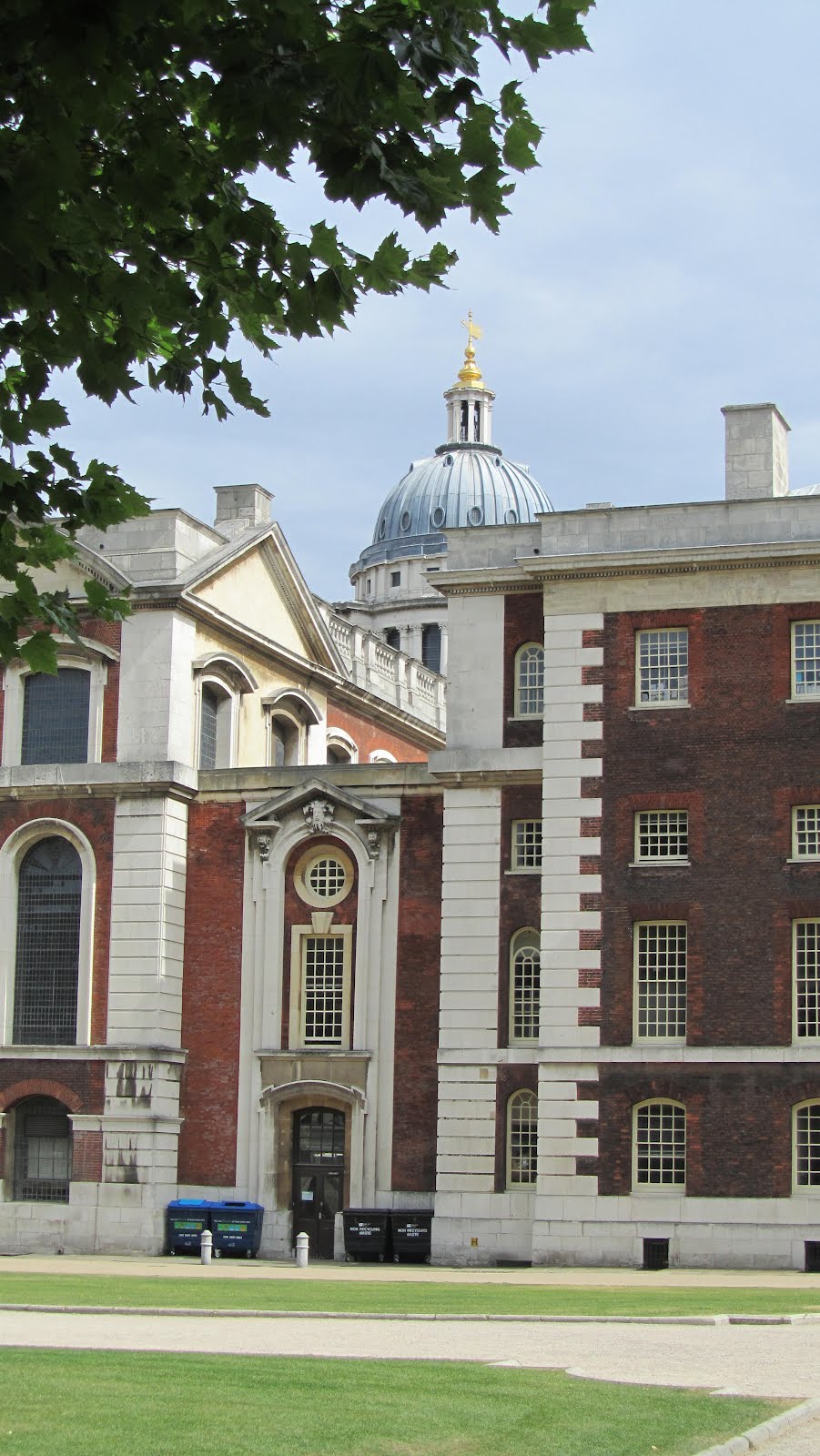
For a birthday treat, la Masignora chose a visit to London, with an exhibition at the Maritime Museum in Greenwich its focal point. If you are able to get there, do. It's only on for a few more weeks. It is just marvellous, leading us through time from the Tudors to the present day and showing how each generation had its favourite home on the river, from Windsor in the west to Greenwich in the east. The greatest palace builder of them all was Henry VIII, and a recent commentator said he had contributed more to English Architecture than any other monarch - without also saying that he had destroyed some of the greatest buildings in the land, including Fountains Abbey and the other great Monastic Houses in the North and so many other wonderful buildings. In Oxford work on Christchurch ceased under Henry, and the planned Cathedral was abandoned; all Henry left that poor diocese was a shorn off fragment of a Nuns' church which also has to serve as a college chapel. But more of that another day, perhaps.


The curator of this exhibition (the "Guest Curator" he is called) is the historian David Starkey. Perhaps it only strikes a member of the Ordinariate just how many of those connected with the River were Catholics, from Henry VII and Cardinal Wolsey to Pugin whose crockets and finials make the Palace of Westminster so memorable.


For Pugin it was his faith which inspired his architecture. Few people have had such an effect on English buildings, from the Houses of Parliament to parish churches, railway stations, Civic Halls - every 'gothic' building from the 19th Century to the present owes something to Augustus Welby Northmore Pugin.


There were some marvellous juxtapositions. The stern of the 'Royal Prince' is on display in England for the first time since the dastardly Dutch made off with her. Nearby stands a portrait of Charles II's brother James, depicting his Naval prowess; he led the fleet which defeated the Dutch at the battle of Sole Bay. Then it is up river again to Hampton Court, with the additions to Wolsey's great Palace (appropriated by Henry VIII of unhappy memory) made by William and Mary.


So next to the last Stuart King is the unspeakable William of Orange. He might at least have asked his fellow countryment to have returned the 'Royal Prince'! Little is said about the very last Stuart monarch, Queen Anne, who was such a benefactor of the Church of England. Yet she is famously associated with Hampton Court by Pope (not THE Pope; the other one, the English poet.) "Close by those Meads for ever crown'd with Flow'rs, Where Thames with Pride surveys his rising Tow'rs, There stands a Structure of Majestick Frame, Which from the neighb'ring Hampton takes its Name. Here Britain's Statesmen oft the Fall foredoom Of Foreign Tyrants, and of Nymphs at home; Here Thou, great Anna! whom three Realms obey, Dost sometimes Counsel take--and sometimes Tea." (Alexander Pope: the Rape of the Lock.) Wren began builsing the Royal Naval Hospital (site of the present Museum) in Mary Stuart's reign, and it was being built throughout Anne's reign, only completed under George I (and the Chapel finished even later).


There is much in the exhibition about the Hannoverians, with their fondness for domesticity at Kew - it was the retreat where Royal Princes could escape their fathers. All the 18th Century Georges, it seems hated their sons, who reciprocated enthusiastically.

It is ironic that this exhibition, created to mark the Queen' Jubilee, should also have so much about successive Royal Yachts. The Victorian Yachts had the most splendid fitiings and furnishings, the very last of the line, Britannia, was a favourite of our present Queen and the Duke of Edinburgh. Had the yacht remained in service until the present day, it is unthinkable that there would not have been a replacement. The mean-spirited decision to decommission and not replace her in 1997 is unlikely to be reversed (despite promises to do so by various Conservative leaders) in 'the present financial climate' - excuse for so many unfulfilled Government promises.


For me an outstanding feature of the exhibition was the Lord Mayor's Procession. Until 1857 this was a great River Spectacle; all the Livery Companies had their own barges, with uniformed crews vying with each other. Now the Lord Mayor's Show is all on dry land, and a poor substitute for those great waterborne events. Many of the livery companies have surviving relics of their barges; and amazingly several of them had figures of their patron saints. To carry an image in procession now would certainly give rise to charges of "Popery" - yet from well before the Reformation right until the reign of Victoria life-size images of many saints were processed along the Thames to escort the Lord Mayor. Above you may see Peter, of the Fishmongers' Barge, the gilded St Dunstan of the Goldsmiths, and Catherine of Alexandria, of the Haberdashers' Company. Will there be a Lord Mayor who will reinstate the Saints in his Lord Mayor's Show?


ps HACKED TO PIECES


IF YOUR EMAIL IS IN MY ADDRESS BOOK IT IS LIKELY YOU WILL HAVE RECEIVED A SPAM MESSAGE ABOUT CHRISTMAS GIFTS; I fear the address book has been hacked. Is there anyone who can advise me on what to do about it? Or shall I have to find another Server and start all over again... HELP!

Tuesday, 31 July 2012

The Ordinariate Grows


The grass was still being mown at the Church of the Holy Redeemer, on the outskirts of Salisbury, as we arrived. In the distance Bishopsdown glowed in the evening sun. David Boundy was to be ordained priest in this church by Mgr Declan Lang, Bishop of Clifton, to serve in the Ordinariate. It is good that Fr Keith Robinson, the Pastor of that Group, will now have a colleague.


The Group shares the church with the local parish, and evidence of the generosity of the Parish Priest, Fr Michael Fitzpatrick, is the notice on the church door announcing the Ordinariate's times of services. Perhaps other parishes will follow suit? Or maybe most already do and it's just that I have not experienced it. Fr Keith was previously Vicar of St Martin's Salisbury, and Fr David had assisted him there in his retirement, so it is good that the same team is now working together in the Ordinariate.


There were four Deacons of the Mass, and ten concelebrating priests. The diversity of chasubles indicated old friends of Fr David from the diocese of Plymouth (David had parishes in west Cornwall and north Devon), from Clifton (where the Cathedral is in Bristol, but the Diocese covers Somerset and stretches as far east as Salisbury), from Portsmouth and London and, of course, from the Ordinariate. Servers came from all the Catholic parishes in Salisbury.


Making a dash for the Reception after Mass


Afterwards there was a photocall; Fr Keith is on the left here, next to him Mgr Andrew Burnham, then Bishop Declan and the newly ordained Fr David.


Thursday, 26 July 2012

Spinnaker Revisited


Part of Portsmouth Harbour seen from the Spinnaker Tower


If you follow 'the Anglo-Catholic' you will know there have been some problems (for me) in downloading pictures. There I was, halfway through a fascinating travelogue, only to have the system jam on me again. I hope this blogpost will work, since the views from the Spinnaker Tower are just wonderful.


Here first is the Ordinariate Church of St Agatha, the redbrick building with three lancet windown in the centre of the view. The tower in front of it is part of the Navy's barracks (though I fear the RN has lately adopted the transatlantic jargon and now calls it a "Naval Base") and a little beyond it the grey stone turret is on All Saints, one of the City Centre Anglican Churches.


St John's Catholic Cathedral is also redbrick, and again the turret and dome of another building partly obscure it.


The Anglican Cathedral of St Thomas of Canterbury is just beyond the ferry harbour in this shot, with beyond it the green grass of Southsea Common. Today there was a slight heat haze, and the windows of the Spinnaker have given all the pictures a strange blue glow - but I hope you can discern some of the land and sea-marks.


You should be able to make out HMS Victory, Nelson's flagship, at present awaiting the reinstatement of the top of her masts and rigging - probably for the twentieth time or so since she was put in dry-dock here.


The Narrow Harbour Entrance.


The Isle of Wight in the background


PS: I see there is a post on the Anglo -Catholic site asking for us to vote on what rite we want to use, the new Translation of the Missal or some as yet unseen version of Dr Cranmer's interesting little experiment. Since only 24 have so far voted the result is hardly overwhelming. If you are not completely fedup with the result of voting in Synods and such, do go to the Anglo-Catholic site and add your cross to the ballot paper.