Monday, 2 January 2012

Party Time


Today we had Open House for members of the Bournemouth Ordinariate Group. Some are away, some down with a dreadful cold, two had car trouble on the way, others again had no transport. Fortunately no one had an ox to try out, nor had anyone married a wife, so in the end more than a dozen managed to find us and squeezed into our little house in Lymington. Accordingly, full justice was done to Jane's cooking.


It was especially good that Fr Danny McAvoy, our local parish priest, joined us.

We furthered our plans for the great visit to London on Jan 15th - Evensong and Benediction at St James' Spanish Place (hope to see you there - 5pm Mgr Keith presiding) and before that a more local event also involving our Ordinary.


On Saturday next at 12.15pm Mgr Keith will be celebrating Mass, and receiving into the Catholic Church Bishop Robert Mercer, CR. This is at St Agatha's Portsea, one-time church of Fr Dolling. If you wish to attend it might be helpful to let Fr Jonathan know (j.redvers_harris@virgin.net)

Washing Up Volunteers

Let's enjoy these small domestic events. When numbers grow, as surely they will during this year, we shall be using Church Halls rather than private houses. We should make the most of these more intimate occasions while we can.
Posing by the puddings

Sunday, 1 January 2012

A Jewish Mother

The internet is abuzz with news about the new arrival. Fr Jeffrey Steenson is to be the new Ordinary of the latest Ordinariate, of the Chair of St Peter. My own particular delight is that another former student of St Stephen's House achieves high office in the Catholic Church. Fr Scott Hurd trained with us there and now he is to be a top gun in the Ordinariate; Vicar General, no less. It couldn't happen to a nicer chap.

Here our little Group in Bournemouth is planning a coach for Jan 15 to take us to the Ordinariate Evensong & Benediction at St James', Spanish Place. There are still one or two seats left, so if you are interested let me know. We are hoping there may be a few from the Salisbury Group joining us, too.

This morning, we worshipped with the parish congregation of Our Lady Queen of Peace. Fr Gerry invited me to concelebrate and preach: and here is what I had to say on this happy day:

As for Mary, she treasured all these things and pondered them in her heart.

Mothers have a great gift – the gift of embarrassing their children. When the son brings a girlfriend home for the first time, there is mother with the photograph album, ready to let the girl see just what a geek the son was with those braces on his teeth. It is not done with any malice; it is just that to a Mother, her son is always that, her boy. And she remembers so much from his childhood, since it was so important to her. When she was in her nineties my own mother would speak about me. How old is your son now? they would ask. ‘Oh, about forty’ she’d say - very flattering, when you’ve already had your seventieth birthday; but she could just as easily have said “about twenty” or “about fifteen” – that’s how she remembered me.

So it was nothing extraordinary that Mary remembered the events surrounding her Son’s birth – every mother does it. But every mother does not give birth to the Son of God, and the time of Jesus’ birth has been remembered not just for a lifetime but for two millennia. And whereas the day I fell out of the pram, or the day I learned to ride a bike are just the sort of thing that happens to everyone, the day the shepherds came to the stable is eternally significant. Yet unless Mary had treasured these things and pondered them in her heart, they would have been lost to us.


So Mary is a typically proud mother, indeed a proud Jewish mother; but her son never studied to gain an ology (do you remember Maureen Lipman in the BT ads?) What Mary had to remember about Jesus was vastly more important; this child, she was told by Simeon, is set for the rise and fall of many in Israel. She was to be the Mother of her Lord, the Mother of God himself.

There was a Muslim scholar speaking on radio recently, trying to show how inclusive and reasonable Islam was; “but we believe the Bible”, he said, “we honour the prophet Jesus and his virgin mother.” Don’t be deceived. Like every heresy throughout history (and Islam is a heresy, a distortion of Christianity) Muslims pick and choose which parts of Holy Scripture they will believe and which they will ignore or deny. It was like that way back about four hundred years after the Resurrection, centuries before Mohammed was born. There was a false teacher, a monk called Nestorius, who refused to give Our Lady the title “Mother of God” – or rather its Greek version, Theotokos, the God-bearer. For two hundred years that had been how orthodox Christians spoke of the Blessed Virgin; she was the God-bearer. The person who first used the phrase was Origen, and it caught on as a perfect description for the role of Mary in the Christian story. She brought the Son of God into the world; she bore God in her womb. Well, Nestorius did not like it; to him it sounded as though this was damaging Jesus’ humanity. He was fully human – and Mary gave birth to a human son. Eventually it took a Council of the Church, the Council of Ephesus, to decide the matter. That decision we firmly hold, as Catholic Christians; that Jesus is fully human, and fully divine. The Blessed Virgin did not give birth to two sons, but to one, Jesus, and her Son is properly called Son of God and Son of Man.

In all this, the Church relied on what Mary had remembered and what St Luke and others had written from what she told them. She who had seen and heard and experienced all these things treasured them, and pondered them in her heart. She is, before anyone else, the first Christian theologian, the one who contemplated the mystery of Jesus’ birth and realised that this was, indeed, Son of God.

You will find Christians who shy away from the word ‘theology’. They say they are simple Christians, and they are worried by dogma. Theology, though, is simply an attempt to find out the truth about God, and give a coherent account of Him. Doing this, we also have to discern the truth about his creation, especially about human beings. That was the aim of those who wrote scripture; from the first page of Genesis, the question is how mankind came into existence, and how we are connected with our Creator.

The Nativity of Jesus is the greatest step in this journey of discovery; that is what this whole festival is showing us. When the appointed time came, as the Epistle tells us today, God sent his Son, born of a women, born a subject of the Law; that is, he was fully human, governed by the laws of nature as we all are. Unless he had been like us in this, we could not have become like him. But he is truly Son of God, who is sent into the world; and so the Spirit who is in his Son can interact with our spirits, enabling us to cry Abba, Father.

This is why theology matters. The Church’s teaching about God and man is based firmly on Holy Scripture - and especially on how Mary kept all these things and pondered them in her heart. When we pray, when we work at the meaning of the words of Scripture, when we wrestle in our minds with the teaching of the Church, we are honouring Mary – for this is what she did, and our praying and pondering continues her work in this generation. So you see after all this Jewish mother is concerned about an ology. Not Sociology, like Beattie in the ads; but theo-logy; the study and knowledge of God himself.

If Mary had not treasured all these things, from the visit of Gabriel to the birth in the stable, from the visit of the shepherds to the need to become refugees in Egypt, if she had not pondered these things and entrusted their meaning to Our Lord’s disciples, our knowledge of God, our theology, would have been very deficient. As it is, we can trust Mary the theologian more than any other teacher; and part of her lesson is that we can become a little like her if we will treasure these things, and ponder them in our heart too.

Friday, 30 December 2011

Welsh Festivities


Ancient Cross in the Church in Wales' Parish Church in Llantwit

Months ago, before I had the responsibility of caring for an Ordinariate Group, we arranged a Christmas break with family in South Wales. Thanks to Fr Gerry, our parish priest in Bournemouth, I was able to fulfil that commitment, and our Group worshipped with the parish on Christmas Day. So we shall again on January 1st, though this time I will be able to preach and concelebrate.


Llanmihangel Church
In Wales you are in the land of the Saints. It is even said that in the ancient Monastery attached to the Church of St Illtyd in Llantwit Major, both Patrick and David received their education. Our daughter lives a few miles away in a hamlet called Sigginstone, where there is only a pub and a handful of houses. The Church of St Michael (Llanmihangel) is a mile away down a lane, and very lovely it is, hidden in its dell from any Danish marauders.


Our Lady & St Illtyd Catholic Church
The Catholic Church is rather more modern, but greatly loved by its parishioners. Fr William Isaac, the Parish Priest, invited me to celebrate the midnight Mass - he was at one of the two other churches in the parish, in Bridgend. Later on Christmas morning Fr Tim, his assistant priest, celebrated and preached and I concelebrated with him. Then on St Stephen's day I said Mass once more in Our Lady & St Illtyd's - and told the congregation a little about St Stephen's House in Oxford, and how it continues to provide priests for the Catholic Church (as well as a few for the Church of England). Now our Ordinariate Group is laying plans for 2012, beginning with Solemn Evensong and Benediction at St James' Spanish Place in a fortnight, and continuing with several of us joining the Ordinariate pilgrimage to Rome at the beginning of Lent. Meanwhile Jane is cooking endlessly, ready for an invasion this Monday, January 2nd, when we are declaring Open House for our Ordinariate Group. Hope we are strong enough!

The Catholic Church in Wales is not a separate entity from the Church in England; [Scotland, of course, is another matter altogether]. I found it interesting to discover that the Province includes Herefordshire, over the border in England, with the Archbishop of Cardiff caring for them all. So when the Ordinariate grows in the Principality, it will simply be another part of the Ordinariate of Our Lady of Walsingham. May that development begin very soon!

Friday, 9 December 2011

Westward Ho!

On a day of foul weather we headed West to join in the Ordination of an old friend. It was some years since Paul Andrew left the Church of England. Now at last he is a Priest in the Catholic Church - not in the Ordinariate, but a Diocesan Priest of Plymouth Diocese. This means he is on home ground, being in origin a Cornishman.

The Parish Church of the Sacred Heart is a very grand Gothic Revival pile, a worthy neighbour to the Cathedral just a few hundred yards to the East.

I have posted another blog about the occasion at the "Anglo-Catholic" site,so this is just an opportunity to show a few more pictures from last evening.


Mercifully the gale had subsided and the rain ceased by the end of the Ordination Mass, and so many were able to make their way to the Pastoral Centre for splendid refreshments and barely any speeches. Good to catch up with old friends, some in the Ordinariate (Fr Robin Ellis is one of my longest-standing friends - we were undergraduates at Pembroke, Oxford, in the 1950s - and yesterday was his birthday, too). The diocese of Plymouth seems to be largely staffed by former Anglicans, some in the Ordinariate but many who made the journey some years ago.


Of forty priests present last evening I would certainly count fifteen, and probably more, who had once served in the Church of England. How will those numbers alter during the next year, as the CofE moves on its inexorable path towards 'ordaining' women as Bishops? Will many who said "a Code of Practice will not do" live up to their words and join the Ordinariate when no real Jurisdiction is afforded them?

A very pleasant surprise was the hotel where we stayed the night; an ancient coaching Inn which has retained much of its character. The sculpture is in white marble; it is a trick of the camera (perhaps reacting to pigeon guano) which has turned her pink - but she's a jolly image to conclude this blog.

Thursday, 1 December 2011

Inculturation

The Ordinariates have to remain distinct: yet also they are a part of Catholic life in this country. So today I joined priests from the Bournemouth, Avon and Stour Pastoral District on their Advent day of Recollection.

It was a very happy experience. There was some input from one of the brethren, Fr Bill Wilson, and everyone seemed ready to contribute to the discussion which his talks provoked. It seemed a very good way to begin Advent, and we look forward to a similar occasion at the start of Lent.


We met in very comfortable surroundings, Wisdom House in Romsey. This occupies part of the site of a one-time French Convent. It was good to be at home so quickly with fellow priests, only a few of whom I'd met before today. One though, my namesake Fr Bruce Barnes, worked in the Anglican Diocese of Portsmouth soon after I served my Title there, and it was very good to catch up with him again.
It is a stone's throw from another former Monastic building, Romsey Abbey. That church, one of the loveliest in Hampshire, is now the Anglican parish church of the town. The famous local family is the Mountbattens and Lord Louis, cousin of the Royal Family, was laid to rest here.


Portsmouth Catholic Diocese has created a great facility in Wisdom House, and I look forward to coming here again in the future.

I can't leave Romsey without showing you its greatest jewel, the Rood which though much damaged is still magnificent. This early representation of the crucifixion pre-dates the distorted suffering figures of the Middle Ages. This Christ is not victim but Victor, his arms apread out to embrace the world, his feet side by side as though he stands erect. It was the inspiration for the silversmith who created the pectoral cross which I wore as Bishop of Richborough. To have an opportunity to continue in Ministry in old age is a great privilege - to Christ be the glory!


Saxon Rood by the Northeast Cloister Door into the Abbey

Monday, 28 November 2011

Busy Day

Introducing Fr John Hemer MHM
A busy day in London Town began at Our Lady of the Angels, Bayswater, where members of the Confraternity of Catholic Clergy met to hear Fr Hemer on Catholic Scriptural Studies in the light of the teaching of Benedict XVI. It was so good to be reminded that the Scriptures are written "that you might believe that Jesus is the Christ, the Son of God, and that believing you might have life through his name". So much Biblical scholarship in the past Century and more has been undertaken by non-believers. They purport to take an unbiased approach; in fact, theirs is a post-Enlightenment stance which fails to acknowledge the whole purpose of Sacred Scripture. It is written "from faith to faith", not just meant to be dissected as a mere exercise in linguistics. To treat it as such an exercise is rather as though medical studies stopped short with anatomy, and never considered living patients; or as though misicologists studied scores, but never listened to music.


Our Lady of the Angels is a very grand neo-Gothic edifice, with a history going back to that famous one-time married Anglican, Cadinal Manning.


It dominates its corner of Bayswater and makes a grand foil to the Victorian villas facing it across Sutherland Place. We met in the Father Michael Hollings Centre, where we shared a meal and good company - for of course fraternity is one of the purposes of the CCC. We spent half an hour before the Blessed Sacrament, so between those devotions and our Biblical lecture we managed to show something of the two other elements of the Confraternity, Fidelity and Formation.


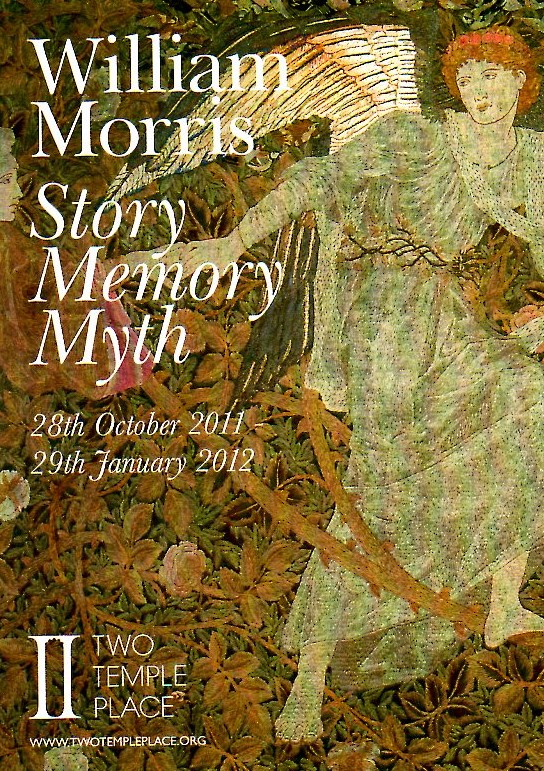
After lunch, rather than rushing back to Waterloo, I diverted to Two Temple Place. I had read about it in the press last week, and thought I should get to see this, one of the last works of the great gothic revival architect, J.L.Pearson.


He was commissioned by William Waldorf Astor to build the house, and what an extraordinary piece of work it is - a little Renaissance Palace quite unlike any of Pearson's famous churches. At present it is filled with an exhibition about William Morris, "Story, Memory, Myth". Check with the website (www.twotempleplace.org) before setting out, since occasionally the House in closed for Private events. But if you can get there before January 29th, it is well worth the journey - and what's more, it is free!


Sunday, 13 November 2011

Where's that Patrimony, then? Part 2.

Oh dear: I thought the first half of my address to SVP [yesterday's blog] listed some of the things commonly thought to be the essence of 'The Patrimony' - ancient language, beautiful liturgy, rich hymnody &c - and then added BUT THESE ARE NOT OF THE ESSENCE because they are, or should be, the common concern of all Catholics, not just former Anglicans. Clearly I was misunderstood, since some have asserted that I was giving these priority. I don't; and I hope I said in the second part of my talk just what I DID think was at the heart of our Patrimony. It was about our concern for those beyond the walls of our churches... but judge for yourself, here is how the talk concluded:-

And here we do begin to get to a distinctive element in our Patrimony. Whereas Catholic Parishes count hundreds, even thousands, at Mass, Anglican Parish churches have been used to congregations of seldom more than a hundred. At its best, that has meant that the Vicar has a better chance of knowing his people. It does not mean, though, that he necessarily has an easier time than his Catholic counterpart. When an Anglican clergyman is appointed to his parish, he is inducted to his living. His parish is a geographical area, and until recently all marriages, baptisms and burials in that area were his concern. All the people in that parish were his to look after - and until recently many Anglican clergy tried to visit across the whole of the parish, not simply caring for nominal Anglicans. It is this sense of responsibility beyond a congregation which is, I believe, at the heart of our mission.

By being part of the ‘established church’, whatever that means now, the Anglican cleric has had the time to be a pastor to a whole community. At its best, that has meant that he would visit anyone in hospital - not just Anglicans, certainly not just his own flock - and from those encounters there would occasionally be a real conversion. So too with funerals. If in doubt, a person would be put down as ‘C of E’ – and that too gave, and gives still, great opportunities for genuine evangelisation, when bereaved families are visited before and after the funeral.

When we moved to our retirement house ten years ago there was still a hospital over the road. They built a new hospital, and gradually houses were built on the site opposite us, forty-one of them in the end. It gave me a conscience that I had no right to visit them. In my parishes I would have seen those newcomers as both responsibility and opportunity. If I’d not called myself, someone from our visiting team would have been there while the boxes were still being upacked, with a parish magazine to leave so that they knew when we met for worship. We had people keep en eye out for removal vans across the parish. The first few days after arrival were the best time. No one wanted you to stay very long, but you could answer questions about the neighbourhood – the doctors, the schools, the bus service – and your visit was often remembered many years after. A young couple were in my study preparing for marriage. ‘I used to be in the police’, she said. ‘I remember you visiting the Station soon after you arrived. We did not know why you had come, but we were glad you had’. It was as though being part of the Church of England gave us a right – and a duty – to do such things. I hope when eventually we get our Catholic parishes we shall continue in this way. I am sure some of the Ordinariate priests already are doing so. It is second nature to them.

Being part of "The Church of England by Law Established" gave us confidence to do this. Now if we believe that the Catholic Church really is meant to be the Church of this land, perhaps we can all rediscover this attitude, this sense of responsibility for entire communities - not just for those who happen to come to mass, or who had an Irish grandmother. It may be there are Catholic parishes where this happens; I hope so, and it would be good to hear your experience of this, and whether I am being quite unrealistic.

Last week they showed something of the funeral of Jimmy Saville. Typically, the BBC said nothing about how his fund-raising for Hospitals was inspired by his faith - and that is annoying. Then, when it showed the Procession coming out of Leeds Catholic Cathedral the commentator said something about it being “the City’s Cathedral” – once again I began to be annoyed. Then it occurred to me that perhaps this was of a piece with the way in which Archbishop Vincent is often asked for a religious slant on a news item when in the past it might have been the Archbishop of Canterbury. They say the Queen used to refer to Basil Hume as “My Cardinal”. It may be that gradually the Catholic Church is filling the space which was once claimed by the Church of England as the National Church. The Anglican Church is finding it ever harder to address the nation, and when it does, as in the St Paul’s affair, it does so with confusion. We should be getting bolder in using the media, expecting Catholic voices to be heard. I think there is a group of laypeople who are doing just that nationally. Perhaps we need to have more people locally making frequent contact with the local press and radio and TV; and if you are already doing it, hurrah, and let us know about it.

If, after all this, you say “But that is nothing different from what Catholics have always done”, that’s fine. It simply means our so-called Patrimony is less distinctive than I thought. But I believe it is an attitude to the outside world which the Holy Father wants us to develop - "The Church in the market place" - and something for which our Anglican experience has particularly qualified us.

Yet the truth is, we are Catholics. This week I have celebrated two masses for the Ordinariate – both of them straight from the new missal – and three masses in local catholic churches, where our parish priest is very hard-pressed. Our Group Council has decided that we should only have two masses each week which are billed as being ‘ours’, on Sunday at 9.30am and on Wednesday at 10.30am. The only difference between them and other masses celebrated in the parish is that we name our Ordinary, Keith, in the Canon, besides Crispian our Bishop. If we go to Mass on other days, we join our local Catholic parishes.

It is a delicate balancing act we are engaged in. We try to be as supportive as possible to our local churches, while keeping a distinct place for Anglicanorum Coetibus, groups of Anglicans. In our Ordinariate worship we are often joined by others, friends from St Joseph’s in Christchurch where the priest prepared our people for reception into the Church, from Our Lady Queen of Peace itself, and from other parishes – people who want to discover what we are about. What we are hoping to do, little by little, is invite current Anglicans to come and see for themselves what is going on. So many good members of the Church of England are very confused just now, especially those who would call themselves Anglo-Catholics. They were promised that they would always have an “honoured place” in the church of their baptism, but that promise is being ever more frequently broken. As they get more and more marginalised, and as the consecration of women as bishops draws nearer, we are trying to create a place of welcome for them.

We still have a great deal to learn. Our clergy are engaged in an ongoing course of instruction based on teaching at Allen Hall in Chelsea, at Maryvale in Birmingham, and at Buckfast Abbey. Young men with families are adapting to living on less than they were used to, and money is a constant concern for our Ordinary. But none of us regrets the step he has taken, and we are very grateful for the warm welcome and practical help given us by the Catholic Church in England and Wales. Somehow, together, we have to get on with the evangelisation of our nation.


Members of SVP beginning to gather in the Milner Hall